Trust and Obey
Have you ever been running late and stuck in traffic? The feeling is not fun. Your will desperately wants to move forward, but the light is red and the line of traffic keeps you standing still. This experience repeats for us in a multiplicity of ways, but the common thread remains the same: a feeling of frustration when reality proposes an impediment to your own will.
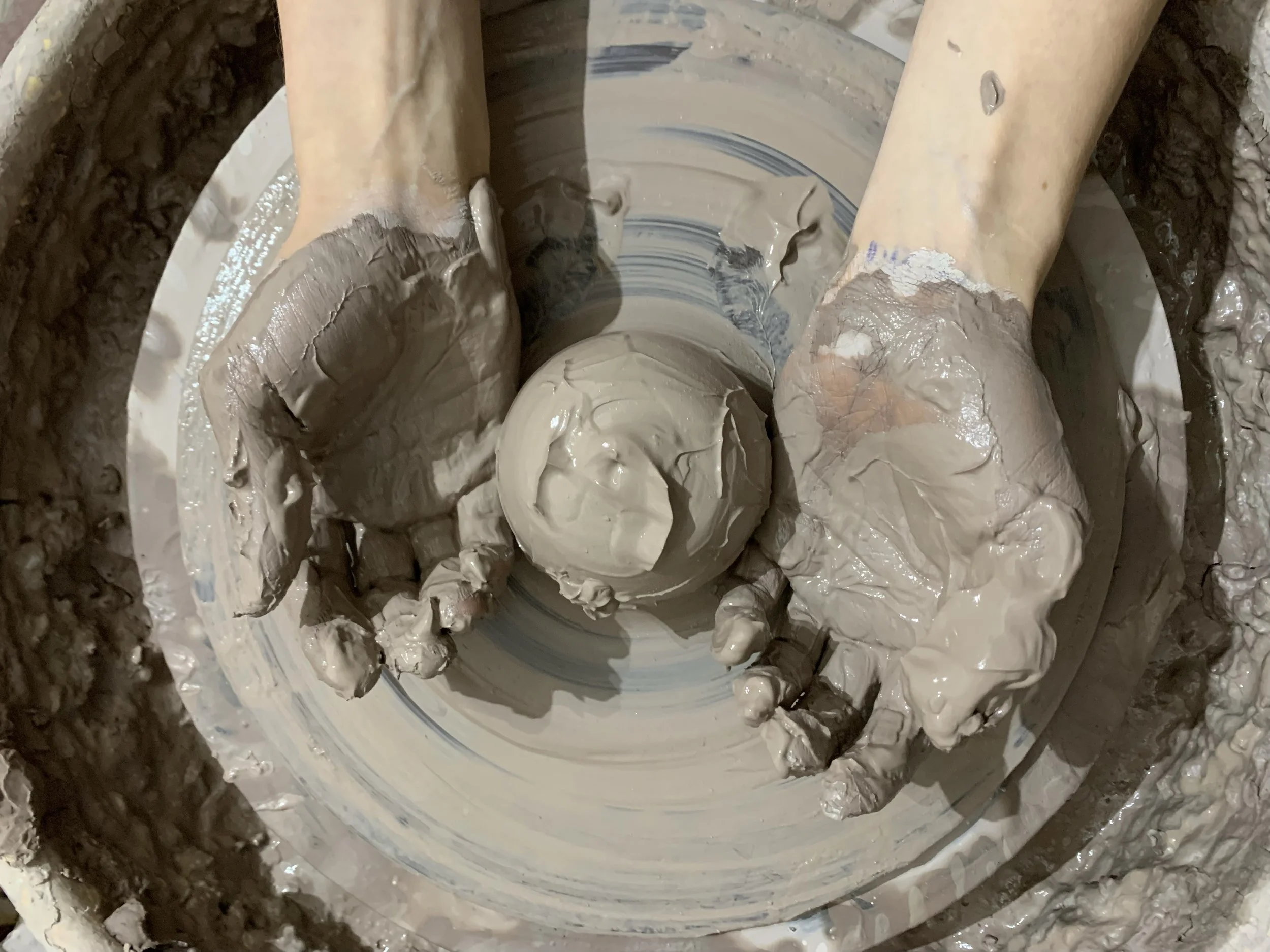
Recently, I was throwing a pot that from the very beginning would not center. There was a spiral in it that persisted even though I tried many times to bring it up and down again to correct it. I experienced this inner frustration, which felt the same as when I am striving by my own plans and not accepting the reality of the situation before me.
What is the answer to this futile frustration? It is surrender. It is the same surrender which we can learn from clay that yields to the potter’s hands. The clay does not do anything itself but say “yes” to the hands that are forming it. It is not about the clay’s effort but about its cooperation. It must trust and obey.
As this clay was struggling against my hands, David spoke of a song called “Trust and Obey.” While he had no idea of the connection to what I was internally experiencing with this clay, I saw it clearly. This clay did not trust and obey, and the result was its own frustration, my frustration and, in the end, a frustrated plan.
Yet there is a different way, not only for that pot, but also for the way that we live each day, and that way is yielding. So often we are attached to the way we want things to go or how we planned our day or even our life to be, but then we come to remember that we are not our own makers. While we exist, we did not choose to be created. If “we are the clay and He is the potter” (Is 64:8), then we must acknowledge that we must yield our own ideas to how we should be to the One Who had the idea in the first place.
As I made another pot, my experience was quite different as, this time, the clay yielded to my hands. The clay spun around like it was dancing and opened up like it was singing. It received the messages I was sending it to move in this way or that with apparent joy, and it overflowed with delight as it was being delighted in.
This is the path that is open before us each day, to receive whatever comes to us as a special message from God, most especially when it was not planned. The struggle of releasing our plans is met with the promise of receiving. What we could see as an obstacle is actually a gift given to us to delight us…Now how is getting stuck in traffic a delight? Maybe we don’t always experience delight in the moment, but we can find much more peace and rest when we surrender to God and let go of our plans for His. In the end, we don’t know what is best for us, but our Maker does, and when we yield to Him, we find the greatest joy in receiving all the good that He has planned for us, even if it arrives in unexpected packages.